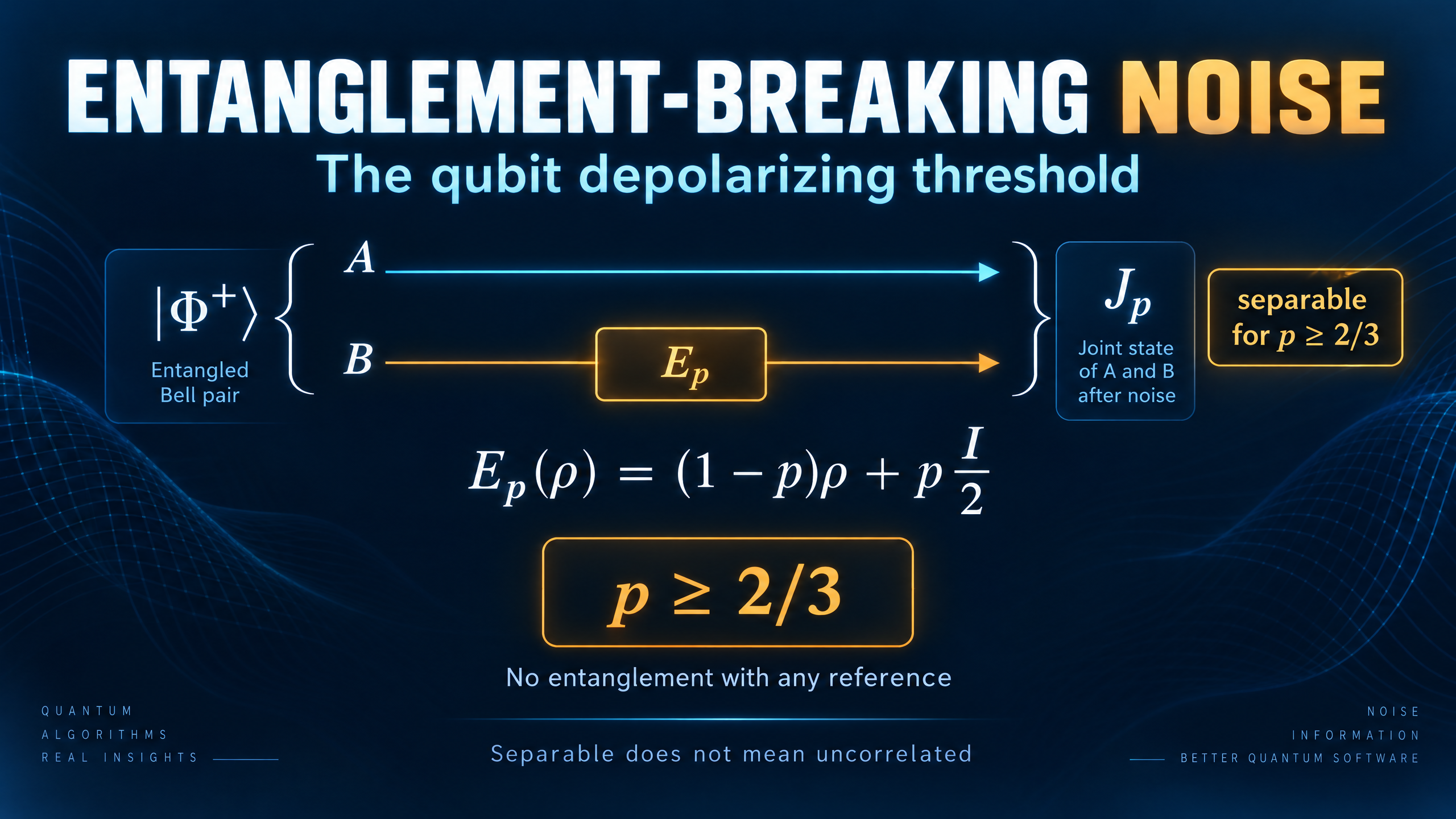
Entanglement-Breaking Channels: Local Coherence Can Survive
A noisy qubit can retain local coherence while losing all entanglement with a reference. Derive the depolarizing threshold and test it with a small NumPy calculation.
A qubit can still have off-diagonal entries in its density matrix after a noise channel has made it incapable of preserving entanglement with anything else. That sounds surprising if we treat every quantum resource as the same thing.
They are not the same. Local coherence concerns a state relative to a chosen basis. Entanglement concerns a joint state shared between systems. An entanglement-breaking channel draws a particularly sharp line between them.
We will find that line for a qubit depolarizing channel, then check it with NumPy. The answer is a precise threshold, but only after we specify what the noise parameter means.
What entanglement breaking actually promises
Let B be the qubit going through a channel E, and let A be an untouched reference system. The channel is entanglement breaking if
(identity_A tensor E_B)(rho_AB)
is separable for every joint input state and every reference system. Separable means the output can be written as a probabilistic mixture of product states. It does not mean the output must itself be a single product state. Correlations can remain even after entanglement is gone.
This is stronger than destroying one poorly chosen entangled input. Conversely, not being entanglement breaking does not mean a channel preserves every entangled input. It means at least some reference entanglement can survive.
Fix the depolarizing convention first
For normalized qubit states, use
E_p(rho) = (1-p)*rho + p*I/2, with 0 <= p <= 1.
Here I is the two-by-two identity. At p = 0 the channel does nothing; at p = 1 it replaces every input by the maximally mixed state. On Bloch vectors, the map is simply r -> (1-p)*r.
The parameter p is not the total probability of applying a nonidentity Pauli error. An equivalent Pauli mixture applies I with probability 1-3*p/4 and each of X, Y, Z with probability p/4. Always check which convention a simulator uses before copying a threshold into code.
Our question is: how large must p become before the channel breaks all entanglement between its output and a reference?
Turn a universal claim into a two-qubit test
Prepare the normalized Bell state
|Phi+> = (|00> + |11>)/sqrt(2),
then apply E_p only to B. This produces the normalized Choi state
J_p = (1-p)*|Phi+><Phi+| + p*I4/4,
where I4 is the four-by-four identity. J_p has trace one. Some references use an unnormalized Choi matrix with trace two for a qubit channel; we do not.
Why can this one special input settle a statement about every input? A theorem says that a channel is entanglement breaking exactly when its Choi state is separable. This is one of the equivalent characterizations in Horodecki, Shor, and Ruskai's foundational paper.
That theorem is doing real work. We are not assuming that the Bell pair is a sufficient test merely because it is maximally entangled. Nor does the theorem mean that one physical measurement on one Bell pair reveals an unknown channel exactly.
Take the partial transpose, not the ordinary transpose
For a two-qubit density matrix, the partial transpose on B exchanges its B row and column indices while keeping the A indices fixed. It is a mathematical diagnostic, not a physical quantum channel that we apply to the qubit.
The eigenvalues of the partial transpose of J_p are
(2-p)/4, repeated three times, and (3*p-2)/4, once.
The first three are nonnegative throughout our parameter range. The last becomes nonnegative at p = 2/3.
For a two-qubit state, positivity of the partial transpose is both necessary and sufficient for separability. Therefore,
E_p is entanglement breaking exactly when p >= 2/3, within 0 <= p <= 1.
The dimension matters. In larger systems, a positive partial transpose is not generally enough to conclude separability. The Peres-Horodecki criterion explains this limitation. Here it is decisive because the Choi state is a two-qubit state.
Verify the threshold in NumPy
The following code constructs the channel from Kraus operators, applies it to half a Bell pair, and checks the analytical expression. The basis order is |00>, |01>, |10>, |11>, with reference A first and noisy qubit B second.
import numpy as np

I = np.eye(2, dtype=complex)
X = np.array([[0, 1], [1, 0]], dtype=complex)
Y = np.array([[0, -1j], [1j, 0]], dtype=complex)
Z = np.diag([1, -1]).astype(complex)
phi = np.array([1, 0, 0, 1], dtype=complex) / np.sqrt(2)
P = np.outer(phi, phi.conj())

print("p         min_PT_eigenvalue   entanglement_breaking")
for p in (0, 0.5, 2/3, 0.8, 1):
    Ks = [np.sqrt(1 - 3*p/4)*I,
          *[np.sqrt(p/4)*Q for Q in (X, Y, Z)]]
    assert np.allclose(sum(K.conj().T @ K for K in Ks), I)
    ops = [np.kron(I, K) for K in Ks]
    J = sum(L @ P @ L.conj().T for L in ops)
    assert np.allclose(J, (1-p)*P + p*np.eye(4)/4)
    assert np.isclose(np.trace(J), 1)
    assert np.linalg.eigvalsh(J).min() >= -1e-12
    # Tensor indices: (a, b, a_prime, b_prime).
    Jpt = J.reshape(2, 2, 2, 2).transpose(0, 3, 2, 1).reshape(4, 4)
    eigs = np.linalg.eigvalsh(Jpt)
    expected = sorted([(3*p-2)/4] + [(2-p)/4]*3)
    assert np.allclose(eigs, expected)
    smallest = 0.0 if abs(eigs[0]) < 1e-12 else eigs[0]
    print(f"{p:.6f}  {smallest: .6f}            {eigs[0] >= -1e-10}")
The smallest partial-transpose eigenvalues are -0.500000, -0.125000, 0.000000, 0.100000, and 0.250000, respectively. The channel classifications are False, False, True, True, and True.
The tolerance avoids mistaking floating-point roundoff at the boundary for entanglement. It is not an experimental confidence interval. Certifying a channel from finite hardware data requires accounting for statistical uncertainty as well as model assumptions.
A measure-and-prepare picture at the boundary
At p = 2/3, there is a concrete way to implement the same channel:
- Choose X, Y, or Z with equal probability.
- Measure the input in that Pauli eigenbasis.
- Prepare a fresh output qubit in the eigenstate matching the result.
- Average over the measurement choices and results.
For an input Bloch vector r, this procedure produces r/3. That is exactly E_p at p = 2/3. The input-output connection can be carried by a classical measurement record followed by state preparation, which explains why the channel cannot preserve reference entanglement.
More generally, every entanglement-breaking channel has a measure-and-prepare representation. This is an equivalence of channel behavior, not a claim that a particular noisy device literally contains a measurement apparatus.
What the threshold does not erase
Take p = 0.8 and input |+>. The output is
[[0.5, 0.1], [0.1, 0.5]].
It still has computational-basis coherence. Yet p is above 2/3, so the channel is entanglement breaking. Its outputs are not all diagonal in a single fixed basis, and it need not erase all classical information.
The thumbnail makes the other important distinction visible: only B crosses the noise box, while A remains untouched. The two outputs form one joint mixed state. Saying that state is separable does not say the outputs are uncorrelated.
The useful programming lesson is to ask which resource a noise model destroys. A qubit can retain a recognizable local state while the channel has already lost the ability to carry entanglement with a reference.