The Blog
66 posts · page 5 of 6

Inside a Transmon Qubit: Why Its Energy Levels Are Not Evenly Spaced
A transmon pairs a Josephson junction with a large shunt capacitance. Its weakly anharmonic energy ladder provides a controllable qubit transition whi…

The Quantum Zeno Effect: How Repeated Measurements Hold a Qubit in Place
A qubit that would rotate from |0> to |1> can stay near |0> when measured repeatedly in the same basis. A short Python example calculates the survival…

Entanglement Entropy: Measuring Correlations in a Quantum Pair
For a pure pair, the entropy of one qubit's reduced state tells how entangled it is. A short NumPy example computes it by tracing out the partner.

Why Clifford Circuits Are Easy to Simulate
Clifford gates can entangle qubits while a stabilizer simulator tracks compact Pauli structure instead of every statevector amplitude.

Build the Intuition for VQE: A Hybrid Quantum Chemistry Loop
VQE combines a parameterized quantum circuit with a classical optimizer to estimate a molecule’s ground-state energy.

A First Quantum Error-Correction Code: The Three-Qubit Repetition Code
The three-qubit repetition code shows how syndrome measurements can detect a bit flip without measuring the encoded logical value.

Why Quantum Circuits Need Transpilation Before Hardware Runs
Transpilation maps logical circuits onto a processor’s connectivity and native gates. Learn how to inspect routing and compiled costs.

Quantum Uncomputation: Clean Up Ancilla Qubits Without Losing the Answer
Compute a useful result, use it, then reverse the calculation to return scratch qubits to |0> without erasing the answer.
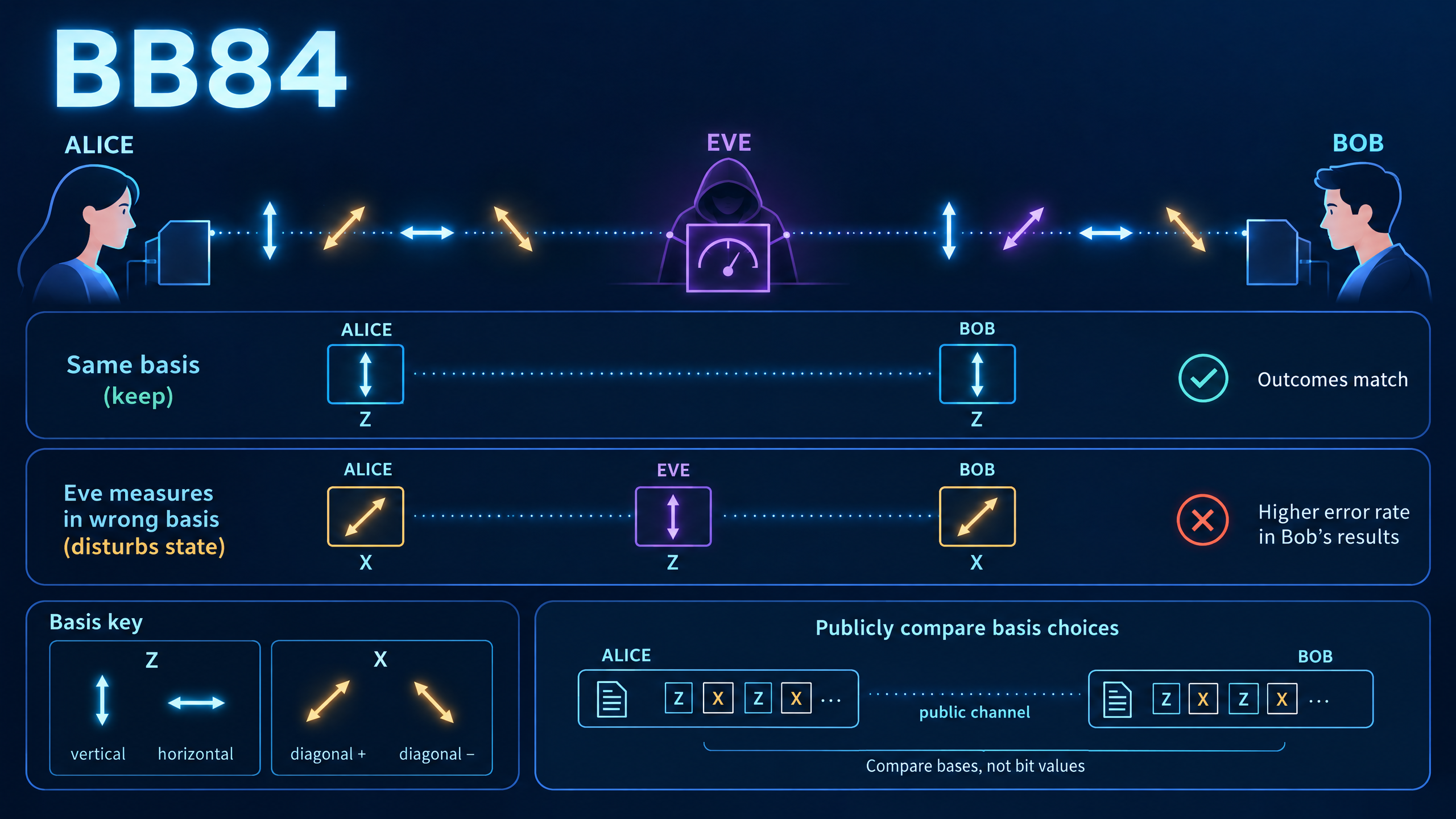
BB84 in Qiskit: How Random Bases Help Two Users Share a Key
BB84 encodes random bits in two incompatible bases. Learn why matching-basis rounds form a raw key, how intercept-resend can add errors, and simulate…

A Quantum Walk in Qiskit: Let a Qubit Steer Motion Around a Ring
A coin qubit directs a walker around a four-position cycle. Build three coherent steps in Qiskit and see how interference changes the outcome.

Quantum Measurement in Practice: From Amplitudes to Counts
Learn how amplitudes become measurement probabilities and how repeated shots turn those probabilities into noisy counts.

Grover’s Search Algorithm: Find a Marked Item in Four Steps
Grover’s algorithm amplifies a marked answer in a four-item search. See how phase marking and diffusion work in a compact Qiskit circuit.